Showing posts with label Masterpiece Monday.. Show all posts

A Joyous Easter Season to You!

We hope you and your family are having a blessed Easter Season. Christ is Risen!


Artist:  Carl Heinrich Bloch

  'The Resurrection'

A Blessed Holy Week to You.

I hope you'll enjoy this painting (fresco, actually) as much as I do. Christ's Entry into Jerusalem
Jean-Hippolyte Flandrin 1842-1848. Current Location: Church of Saint-Germain-des-Prés, Paris


Matthew 21:5
Tell ye the daughter of Sion: Behold thy king cometh to thee, meek, and sitting upon an ass, and a colt the foal of her that is used to the yoke. 


The Triumphal Entry
(Zechariah 9:9-13; Matthew 21:1-11; Mark 11:1-11; John 12:12-19)

28And having said these things, he went before, going up to Jerusalem.

29And it came to pass, when he was come nigh to Bethphage and Bethania, unto the mount called Olivet, he sent two of his disciples, 30Saying: Go into the town which is over against you, at your entering into which you shall find the colt of an ass tied, on which no man ever hath sitten: loose him, and bring him hither. 31And if any man shall ask you: Why do you loose him? you shall say thus unto him: Because the Lord hath need of his service. 32And they that were sent, went their way, and found the colt standing, as he had said unto them. 33And as they were loosing the colt, the owners thereof said to them: Why loose you the colt? 34But they said: Because the Lord hath need of him. 35And they brought him to Jesus. And casting their garments on the colt, they set Jesus thereon. 36And as he went, they spread their clothes underneath in the way. 37And when he was now coming near the descent of mount Olivet, the whole multitude of his disciples began with joy to praise God with a loud voice, for all the mighty works they had seen,

38Saying: Blessed be the king who cometh in the name of the Lord, peace in heaven, and glory on high!

39And some of the Pharisees, from amongst the multitude, said to him: Master, rebuke thy disciples. 40To whom he said: I say to you, that if these shall hold their peace, the stones will cry out.

St Mark's Basilica, Venise Italy

I'd like to begin to share some of the photos from our recent trip to Italy. Here's St. Mark's.


Hubs and me.


The Mosaics. The architecture is Italo-Byzantine.


The stone below the crucifix is said to be a piece of the pillar from The Scourging.


Beautiful Latin Vestments. 


An Illuminated Manuscript.


More Vestments.


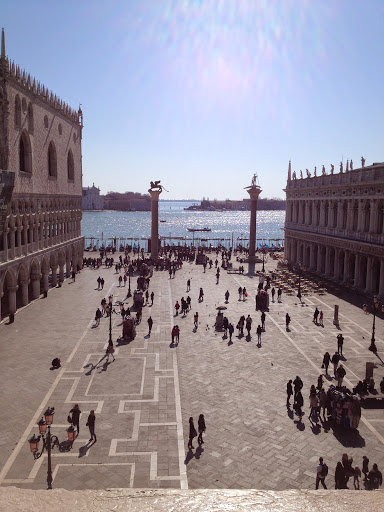
St. Mark's Square.


More Views from the Dome.


Reliquaries.


More Vestments.


A Bronze Relief located Behind the Main Altar.


More Reliquaires.


A bronze figure of St. Mark.


The Twelve Apostles. 14 century Gothic art. 


St. Mark's Campanile, the Bell Tower.


More Ceiling Mosaics. They cover the entire ceiling. I couldn't get over the detail. 


The Facade.


More of the Facade.


The Pillars. 


Altar Coverings.


View from the Balcony.


Modesty


"William-Adolphe Bouguereau (November 30, 1825 - August 19, 1905) was a French academic painter. Bouguereau was a staunch traditionalist whose realistic genre paintings and mythological themes were modern interpretations of Classical subjects with a heavy emphasis on the female human body.

Although he created an idealized world, his almost photo-realistic style was popular with rich art patrons. He was very famous in his time but today his subject matter and technique receive relatively little attention compared to the popularity of the Impressionists."


When I was in art school, the talk was all about Impressionists and Expressionists and Modern and Post Modern art. Conceptualists and Fauvist, ect. But never Bouguereau. Why? Because modern day art enthusiasts by en large appear to think he's passé. At the point in time that Bouguereau was painting, this sort of Salon art was very popular. Now these days, people look back with a preferential eye towards the innovators. Well, I think his paintings are astonishingly beautiful. 


“It seems to be the fashion nowadays for a girl to behave as much like a man as possible. Well, I won't! I'll make the best of being a girl and be as nice a specimen as I can: sweet and modest, a dear, dainty thing with clothes smelling all sweet and violety, a soft voice, and pretty, womanly ways. Since I'm a girl, I prefer to be a real one!” 
― Mrs. George de Horne Vaizey 

The Visitation


The Seattle Art Museum houses Philippe de Champaigne’s (French, 1602-74)The Visitation. I saw it for the first time when we visited there this past summer. It's all about the eyes here.The eyes are where Mary and Elizabeth's dialogue happens. They are so intimate. They're embracing and they're positioned cheek to cheek with their hands clasped together creating an anchor in the foreground. Symbolically as well as literally, Zachariah is off in the distance and St. Joseph is a little closer. Both men look on. With her other hand, Mary is pointing. It is she who God has chosen to bring the Messiah to the world.  

Irene.


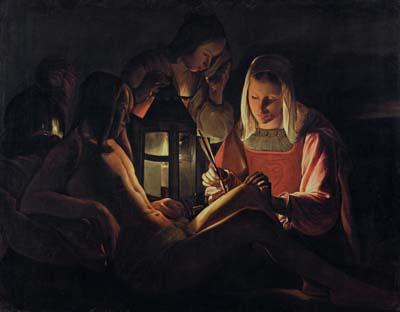
The theme has been reinterpreted many times in art history, primarily in the 17 century;  St. Sebastian tended to by St. Irene. I've only put up a few examples here, however there are many more to be seen if you care to do a Google search.

Here are the holy women, St. Irene with her attendants in these first two reproductions. They are nursing his wounds by candlelight. 

See how calmly Irene removes the arrow? I suspect Georges del laTour must have been a serene individual. His paintings always come across that way; with such an air of serenity. 


Georges del la Tour, St. Sebastian tended to by the Holy Women. 

St Irene and St Sebastian both lived in Rome during the Reign of Diocletian. The Emperor sentenced St. Sebastian to be put to death. Intending to bury his arrow ravaged body, the widow Irene found Sebastian still clinging to life, so she nursed him back to health.


Georges de La Tour. 
St. Sebastian Tended by St. Irene. c.1634-1643.


Through these paintings, St Irene became an icon of Catholic charity during Post-Reformation times. Don't you think we need more 'St. Irenes' in the Church today? What with all the bickering that goes on. Perhaps the extent to which religious persecution exists also (unfortunately) measures the amount of infighting and bickering. Because Christians can't afford to argue when the arrows of their real enemies are flying towards them. You know?  


Hendrick ter Brugghen 
Saint Sebastian Tended by Irene, 1625

In this last painting above, Brugghen places great emphasis on a two dimensional composition. The artist dramatically packs all the action up in the foreground. The sun is setting behind them, and yet one can clearly see there's also a source of light in front of them. That's curious. I wonder what the artist meant to imply by that. Perhaps it's some kind of metaphor. The light in the background is the natural light, which is setting, while the light that comes from beyond the foreground--which is a far greater light, is a supernatural light. I wonder if the artist is saying that the ruler of this world (the meaning of the name Lucifer is 'carrier of the light') is soon passing away. The light of Christ now reigns, despite any arrows; despite any and all circumstances we may find ourselves in that seemingly contradict His victory. We wait in joyful hope. We are so lucky. Deo gratias!


Masterpiece Monday: St. Flavia


Sometime shortly before Christmas, I was watching an old flick on Turner Classic Movies station called "Tenth Avenue Angel." It stars the child actress Margaret O'Brian as Flavia Mills. Here's the movie synopsis: "A child of the tenements helps an ex-con find a new life." It's a sweet movie. As I was watching it I was thinking, "Flavia, Flavia....Where have I heard that name?" 

Later that day it came to me. Flavia is the name of the company that makes the coffee machine my husband was getting for Christmas! I'd ordered it online just a day or two prior to watching that old movie. 

So right away I had to do a Google search to see if there was actually a St. Flavia. Yep, there is! And I had it in mind to name a veil for her. Or in this case, I renamed a veil for her. I finally got around to it just this month. To see the Flavia veil, just check out the blog entry that's directly below this one. 


In his High Renaissance painting (above), Perugino depicts St. Flavia (the younger) wearing a crown, because she was the niece of the Emperor Domitian. She was later banished by her uncle to the island of Pontia along with other Christians whom St. Jerome describes as experiencing a "slow martyrdom" there alone on the island. St. Flavia is wearing the red robes of a martyr here, as she was later burnt to death under the Emperor Trajan for not sacrificing food to idols. As in so many of Perugino's works, the saint's hands are held in prayer, and the head is tilted back as she gazes up towards the heavens. She appears to be listening and receiving instruction more than petitioning. Perhaps Our Lord was preparing her for the trials that lay ahead. St. Flavia was buried in the catacomb on the Via Delle Sette Chiese which was originally the vault of Saint Flavius Clemens and his family.

I dearly love the virgin martyr saints. St. Anges, St. Cecilia, St. Lucy, St Joan and so many more.... Does our modern world desire strong women? We do well to look to the past for role models. These girls were determined and virtuous little mights. Would that there more girls like that today!


Magdalene

Here's a veil that I made over the summer and then named after a much beloved saint. Her feast day coincides with mine and my husband's wedding anniversary, so I consider her one of our family saints.


The Magdalene in this painting by Georges del La Tour reminds me of Linda, my old roommate from college. Linda has the same sort of hair and frame as this Magdalene. We converted back to Christianity at around the same time, and the painting reverberates with great relevance for both of us!


And there's so much symbolism in this piece. She gazes into the mirror of introspection, and considers her life thus far.  The candle is symbolic of her time here on earth. The broken jewelry on the floor shows she no longer cares for the things of this world. The skull; mortality. Magdalene is considering the last things; death, judgment heaven and hell. The length of the flame, the dramatic use of light and dark add to the intensity of this moment. Everything has changed for her. Her life will never be as before. She has chosen God above all else.

Claudia

Here's a new veil from Rosa Mystica Mantilla, Claudia. This is a tea stained version of the Joan veil. It's the same Venice lace trim, and the same Chantilly lace in the body of the wrap veil as the Joan veil, only in a different color.


There are two Claudias of note. St. Claudia was the mother of Linus, who was the second Pope. She was one of the woman in Rome whom Paul mentions in second Timothy.

The other was Pontius Pilot's wife. In the Gospel of Matthew, Claudia warns her husband not to condemn Our Lord Jesus to death.

Matthew 27 [19] And as he was sitting in the place of judgment, his wife sent to him, saying: Have thou nothing to do with that just man; for I have suffered many things this day in a dream because of him.


Here above is a beautifully done etching, The Dream of Pilot's Wife, by Alphonse Francois. We see Claudia descending the stairs. She's escorted by her guardian angel who is whispering to her. And she's very obviously troubled. At the top of the stairs, a lamp reveals that she's just now left her bed. The bed sheets are disheveled, indicating that she's had a fitful night's sleep. The rest of the piece reveals the passion, the heavens and a multitude of souls, many of whom are saints. Most are looking on towards Claudia, not Our Lord. They're like a Greek Chorus asking Claudia, "What will you do with this Jesus of Nazareth?"

Our Lord is in fact looking on towards Claudia as well.  He's opened her spiritual eyes in order for her to see, just as He'd previously opened the eyes of the blind men. "What will ye that I do to you?", Our Lord seems to call out to Claudia. He calls to Claudia as He calls to you and I. Do we will Him to be our saviour? 

Joan

Here's a new veil, I'm calling this one Joan.


 Seeing as her feast day came and went recently, and I hadn't yet created a veil in her honor, I thought I'd name this one for her.

Don't you love this painting? I do, anyway. It's titled, appropriately enough, St Joan de Arc. The artist's name is  Jules Bastien-Lepage and it was painted in 1879.


I love the internal stare she has going on... It's really the first thing one notices when looking at the painting, isn't it? Then the outstretched arm. It's understood that she hears the interior voices. Then a backwards glance by the viewer confirms so much. We see the subtle impression of Arch Angel Gabriel and another angel behind him through the trees.

Pasqualina

Here's my Easter veil.... Pasqualina.


The Paschal mystery is the death and resurrection of Our Lord Jesus Christ. On Holy Thursday, Christ instituted the Eucharist, the bread and wine which becomes His Body and Blood. On the Cross, he died for our sins. From the tomb He arose from the dead on Easter Sunday morning. This Paschal mystery continues at each and every holy Mass. Every Mass is the Gospel. It's also Good Friday and Easter all rolled into one.


Here below are some works painted by the Gothic master, Giotto. He introduced something entirely new and different. Giotto broke away from the more stylized Byzantine art that had been on the scene for the previous 200 years. Giotto was really looking at the world around him and painting what he saw. Gotta love him for that.

The Crucifixion.

  The Lamantation:

The Resurrection:
This is all the holy Mass.

"Enter, High Priest, into Thy heavenly Sacristy, and as Thy
earthly ambassadors hold aloft the Bread and Wine do Thou show
Thyself to the Father in loving intercession for us even unto the
consummation of the world. Earth has been cruel to Thee; but Thou
wilt be kind to earth. Earth lifted Thee on the Cross, but now
Thou shalt lift earth unto the Cross. Open the door of the
heavenly Sacristy, O High Priest! Behold it is now we who stand at
the door and knock!"
--Fulton J Sheen,  From his prologue to Calvary And The Mass.

Gianna

 Here's the new mantilla of the week. (Gianna II)


I'm naming this veil for St. Gianna Beretta Molla (October 4, 1922 – April 28, 1962)

She was an Italian wife and mother, and a pediatrician. When it was discovered that she had cancer, Gianna refused to have an abortion. All this came about while she was pregnant with her fourth child. Gianna was fully aware that continuing the pregnancy could result in her death. 


She was canonized as a saint of the Catholic Church in 2004.


Gianna--and really all the saints remind us that our life is not our own. It was given to us by God and is to be lived for God first and for others, too.

Mathew 16: [24] Then Jesus said to his disciples: If any man will come after me, let him deny himself, and take up his cross, and follow me. [25] For he that will save his life, shall lose it: and he that shall lose his life for my sake, shall find it.

This is how Our Lady, who is always the perfect example lived each moment; for God first and then also for others. This is how we take true joy.


Luke:  [38] And Mary said: Behold the handmaid of the Lord; be it done to me according to thy word. And the angel departed from her. [39] And Mary rising up in those days, went into the hill country with haste into a city of Juda. [40] And she entered into the house of Zachary, and saluted Elizabeth.


The Annunciation, by Raphael Soyer.
Soyer was a Russian born artist who moved to the United States in 1912. 


The other "Mary" stands in the foreground contemplating the news. Her demeanor, an inward stare, is like that of countless beautiful paintings and sculptures of the Madonna. Judith Dupre has mentioned in her commentary on the painting that Mary's hands are in the orans position. 

Mary is in prayer.

But about the hands--I'd only add that I think there's significance to be found in their being covered. The hands are used to accomplish things; they're used for work. But I think this Mary's looking to do God's will; to do the work of God and not her own work.
The stark room with that big sink; it looks like a sink that's perhaps rinsed many paintbrushes. Do you think it looks like the old studio flat of an urban artist? I have to wonder if maybe she's the painter's wife. 
Dupre concluded that she's a washer woman, but I don't think so. I'm not sure if that's ever been verified so you'll have to decide for yourself. In any event, I would suppose that the subject is a woman of modest means.

And her slip is, of course Marian blue. 

A painter named Fairfield Porter once said in an interview that blue is the one color that isolates itself from it's surroundings. It's really true and I can see that happening here in this painting. 

Mary is set apart from all creation. 

You know what else sets this "Mary" apart and pulls her almost into another panel of the picture? It's the division of the walls. The one wall directly behind Mary sort of pushes her forward, doesn't it?

This Mary's surroundings are lit in cool tones. Being as she's in her slip do you think that makes her seem a little vulnerable? The sensation of being somewhat chilly and exposed is conveyed here. But the cool tones are also bright tones. Maybe that conveys hopefulness. 

She seems a little isolated, prayerful, hopeful, vulnerable...

And her friend,
 the other "Gabriel" pensively awaits Mary's Fiat. What will be Mary's response?

Assumpta

Here's my latest veil, I'm calling it "Assumpta."

  • Long triangular veil.
  • Made of gold Casa lace.
  • Finished with gold Venice lace trim in the front and gold fringe trim on sides and in back.
  • Measures 19" x 42".

On November 1, 1950, before thousands of people in St. Peter's Square, Pope Pius XII declared that  "the Immaculate Mother of God, the ever Virgin Mary, having completed the course of her earthly life, was assumed body and soul into heavenly glory." This is a dogma of the faith. 


Here it is in his encyclical,  "Munificentissimus Deus" . 
The feast day is August 15th, and it's a Holy day of obligation. 


Assumption of the Virgin (1516-1518) is an altar painting by Titian. All of Heaven rejoices at the gaining of their treasure, and as the heavenly Father draws Our Lady to Himself, a little cherub holds her crown. The Apostles are left here on earth to suffer and carry out their great commission. They are at once with their mother, and without their mother. The Apostles will imitate Mary's perfect example in doing the will of God. Although no longer present, the good mother will remain attentive to their needs.  


There are three levels to this painting: the the dense, entangled and compact earth, glorious light of the heavens above and the mother who is in between. I think the painting shows that Titian understood the way Mary is always between heaven and earth. She continually pleads our cause before the throne of God; she intercedes for us.

Nothing like this had ever been done before Titian; the movement, the large figures, the angles and gestures. The vivid Venetian colors that were characteristic of the painters from this region...  The way these elements all come together to create drama had great influence on the world of art in it's day.


It's located on the high altar in the Basilica of Santa Maria Gloriosa dei Frari, Venice. Here it is below, a High Renaissance painting fitting in so beautifully and harmoniously in it's Gothic setting.


Cecilia

We've had snow again this week. Not as much snow as the blizzard the day after Christmas, still I'd say it was a good 9 or 10 inches here yesterday.  Enough to keep everyone home from work and school. So we all found ourselves with a little bit of stolen time. I used mine to add a few new veils to my ever growing collection.


Here's one. It's named Cecilia. [These pictures are the updated Cecilia--Cecilia II] Do you like it?


 It seemed appropriate to use gold--to my mind anyway--because my husband and I  happen to have a gold relief of the saint in the living room here. 


Much of St. Cecelia's story is said to have been embellished over the years with pious legends. What is most important and true is that she gave her live for Christ.
Her story has been written in some of the classics,
including Geoffrey Chaucer. He tells her story in the "Second Nun's Tale" from  
The Canterbury Tales.


St. Cecilia was a consecrated virgin from a 2nd century noble Roman family. Never-the-less, her father gave in marriage to a pagan nobleman named Valerius. On her wedding day, Cecilia sang the Psalms in her heart, asking God to protect her virginity, even while living in the married state.


In the Raphael painting above, St. Cecilia is listening to the Heavenly Hymns. She's the patron saint of musicians and is almost always depicted with a musical instrument in her hands. Angels often tend to be a part of the theme in the paintings, too. St. Cecilia is the subject of countless masterpieces. 


On her wedding night Cecilia told Valerianus that she was "betrothed to an angel" and that he must not ask to violate her virginity. Valerianus, skeptical, requested to see this angel. Cecilia replied that he must first be Baptized by Pope Urbanus, who was hiding in the Catacombs. Upon returning to Cecilia after his Baptism, the angel appeared and crowned the couple with roses and lilies. The lilies were symbolic of their purity; the roses, of the martyrdom that was to come.

This piece here below is attributed possibly to Pietro da Cortuna.
 

Valerianus and subsequently his brother Tiburtius were moved to conversion and ultimately martyred for Christ. They refused to bend their knee to the Roman idols.  At the command of the wicked prefect, Turcius Almachius, a henchman named Maximus was appointed to swap off their heads. But when Maximus saw the souls of these brothers being received into Heaven, he too was converted and martyred. Then the three men were all buried by St. Cecelia in one tomb. 


 Cecilia was also condemned for refusing to offer sacrifices to Jupiter. She was to be suffocated to death in her own home, by the steam of her own bath. But her guardian angel protected her from the steam.

Astonished to hear the soldiers report that she'd survived the ordeal, the evil prefect ordered her decapitated. Three times the executioner attempted in vain to sever her head from her body. A forth stroke would have been illegal under Roman law. Her tormentor flew in terror, leaving the holy victim in a pool of blood. Cecilia had prayed that she might live for three more days in order to convert souls for Christ, and it is said that she had many visitors, and converted many souls during those last three days. Upon her death bed she asked that her house would become a church. And so it was, and Pope Urbanus buried her among bishops and the confessors in the Catacomb of Callistus. 


  Stefano Maderno's Statue of St. Cecilia (1610) is said to have been sculpted exactly as the saints incorruptible body was found in her tomb in the Catacombs long after her death, which is the position in which she had died. On one hand she had three fingers outstretched and on the other hand just one finger, denoting the doctrine of the one true God in three persons, the Blessed Trinity. Below, the tomb of St. Cecilia under the high altar in Rome. Her body is now in the crypt beneath the sanctuary, in the church built over her house which bears her name.


Cecilia is among the saints remembered by name in the Canon of the Mass.

P:  Nobis quoque peccatoribus     P:  To us sinners,  also,  Thy

famulis tuis,  de multitudine     servants,  who put our trust

miserationum tuarum               in the multitude of Thy

sperantibus,  partem aliquam      mercies, vouchsafe to grant

et societatem donare digneris,    some part and fellowship with

cum tuis sanctis Apostolis et     Thy holy apostles and martyrs;

Martyribus:  cum Joanne,          with John,  Stephen,

Stephano,  Matthia,  Barnaba,     Matthias, Barnabas,  Ignatius,

Ignatio,  Alexandro,              Alexander,  Marcellinus,

Marcellino,  Petro,               Peter,  Felicitas,  Perpetua,

Felicitate,  Perpetua,            Agatha,  Lucy,  Agnes,

Agatha,  Lucia,  Agnete,          Cecilia,  Anastasia,  and with

Caecilia,  Anastasia,  et         all Thy saints.  Into their

omnibus sanctis tuis:  intra      company do Thou,  we beseech

quorum nos consortium,  non       Thee,  admit us,  not weighing

aestimator meriti,  sed           our merits,  but freely

veniae,  quaesumus,  largitor     pardoning our offenses:

admitte.  Per Christum Dominum    through Christ our Lord.

nostrum.    

                    
Above, nineteenth century painter William Bouguereau's St. Cecilia.


Psalm 32
A psalm for David. 

Rejoice in the Lord, O ye just: praise becometh the upright. Give praise to the Lord on the harp; sing to him with the psaltery, the instrument of ten strings.Sing to him a new canticle, sing well unto him with a loud noise. For the word of the Lord is right, and all his works are done with faithfulness. He loveth mercy and judgment; the earth is full of the mercy of the Lord.


Related Posts Plugin for WordPress, Blogger...

Topics

Tales From The Extraordinary Kitchen (42) Catholic Culture (30) Fashion and Style (27) Cloud of Witnesses. (23) Views on Veiling (18) Masterpiece Monday. (16) Women We Love (13) chapel veils (12) Veiws on Veiling (11) Hearth and Home (10) Food and Wine (7) Tales From The Ordinary Kitchen. (7) mantillas (6) Velo Vaticano (5) catholic (5) Chapel veils Rosa Mystica Mantilla (4) head coverings (4) Travel and Pilgrimage (3) head covering (3) mantilla (3) Family and Abode (2) Lace Head Covering (2) Lone Veilers (2) Promo veils (2) Rosa Mystica Boutique (2) Veil of the month (2) benedictus in Domine gloria (2) lace head covering Catholic Mass. (2) modesty (2) rosary (2) traditional faith practices (2) Beef Bourguignon (1) Bishop Sheen (1) Boho Mantilla (1) Bright Pink Veil (1) Brown Chapel Veil (1) Catholic Lace Head Coverings (1) Catholic spirituality (1) Chapel Veil (1) Child's Christmas Veil (1) D-Shaped Mantilla (1) Donald Trump (1) Dt. Therese (1) Eternity Veil (1) Eternity Veils (1) Etsy (1) Etsy Chapel Veils (1) Feast Day (1) Gold Lace Veils (1) Holy Thursday (1) How To (1) Infinity Eternity Mantillas (1) July 26 (1) Last Words (1) Latin Mass (1) Lenten Mantillas (1) Libera (1) Little Girls Veil (1) Liturgy (1) Mantilla Sale (1) Mass of the ages (1) New Veils From Spain (1) Notre Dame (1) Our Lady of Guadalupe (1) Rosa Mystica Boutique Veils (1) Rosa Mystica Mantilla (1) Rosa Mystica Mantilla Veils (1) Rosa Mystica Veil (1) SAVE20 (1) Sisters Trying on Chapel Veils (1) St Ann (1) St Anne (1) St. Gertrude of Nivelles Veil (1) St. Rita of Cascia Chapel Veil (1) St. Therese (1) St.Catherine of Siena Veils (1) Stocking Stuffer Veil (1) Supreme Court (1) The Hair Under the Veil (1) The Mass (1) The Remnant (1) Traditional Catholic (1) Tridentine Mass (1) Veils for trip to Europe (1) Veils on Etsy (1) Veils on Sale (1) Wearing a Chapel Veil (1) beef burgundy (1) black chapel veil (1) bridal party. (1) bridesmaids (1) catholic Jackie Kennedy (1) crock pot (1) faith (1) fire (1) housewives (1) lace color (1) married women and black veils (1) mission in life (1) people of France (1) purpose in life (1) sanctus (1) slow cooker (1) spirituality (1) veil of mourning (1) weddings (1) widow's veil. (1)